Circular Solutions for Zero-Waste Sets in Film Productions
Zero-waste consultancy / 2025The average tentpole film production sends around 40 tonnes of material to landfill. Most of it is set construction waste: plywood, MDF, cement sheet, foam, particle board. Built in weeks, used for months, gone in a day. The trees that became those panels took 15 to 20 years to grow. That ratio of process-time to useful-time tells you everything about where the opportunity sits.
We were engaged by the production teams at Docklands Studios to consult on reducing the waste footprint of a Melbourne production. The brief was straightforward: find ways to divert set construction waste from landfill without adding cost, time or commercial risk to the production.
The production generated 42.56 metric tonnes of mixed demolition material across fourteen skip bins. Under standard practice, nearly all of it would have gone to landfill. We introduced the production team to Smart Recycling in Dandenong, a local business that accepts mixed construction waste and processes it through mechanical and manual sorting into soil, compost, mulch, crushed brick and biofuel. Smart Recycling achieved a 95% resource recovery rate on All Her Fault's waste stream. The cost of sending skip bins there was roughly half the cost of sending them to a tip. That matters. Sustainability that costs more is sustainability that doesn't get adopted.
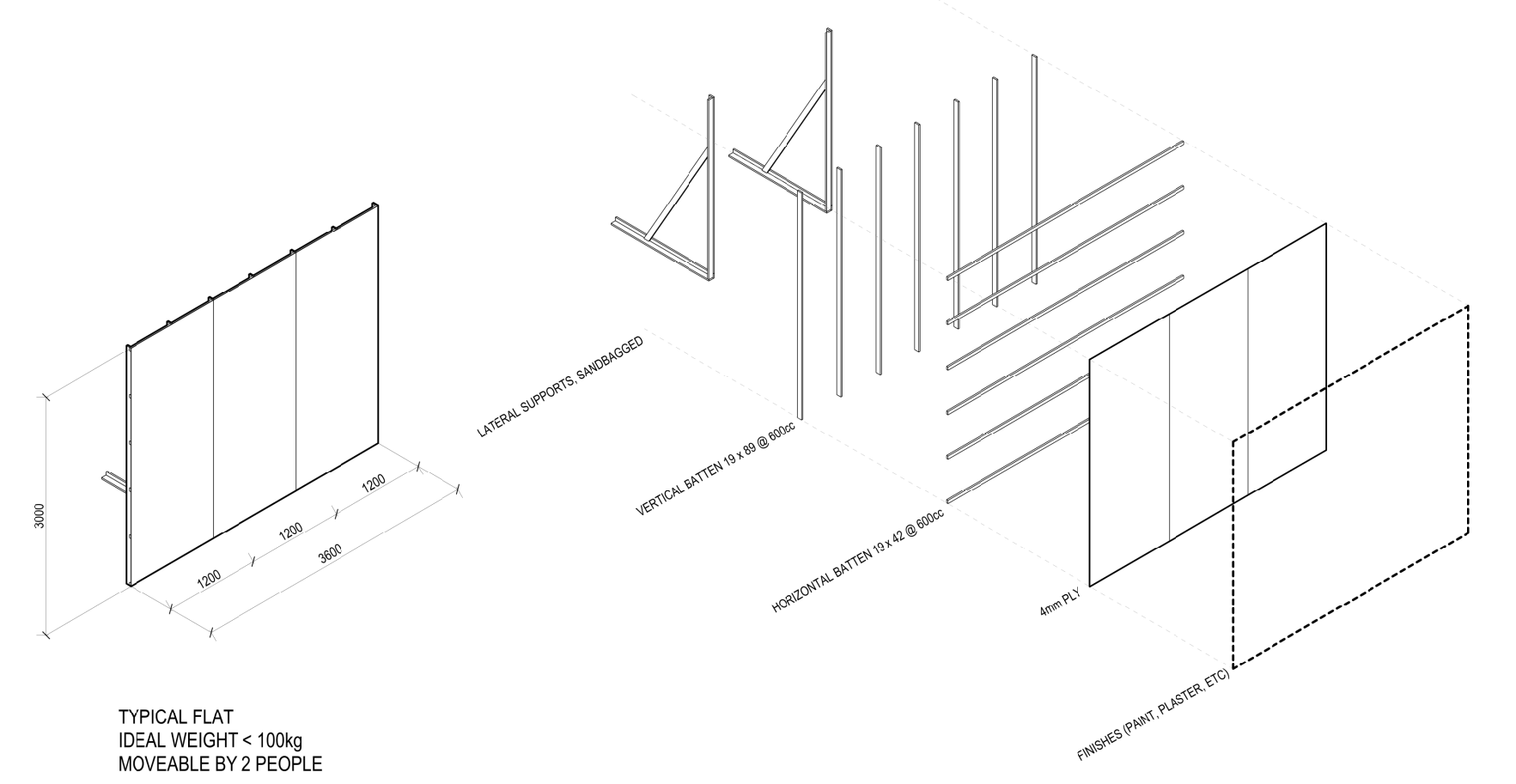
The second line of work was more speculative and, we think, more consequential. Flats are the base building block of every film set: three sheets of 4mm plywood nailed to timber battens, finished with paint and plaster, braced and propped. After the shoot, they're demolished and binned. The surface finishes (nails, glue, plaster, paint) make separation and recycling impractical, so the whole assembly ends up as waste.
We prototyped a circular alternative using Saveboard, a flat-faced panel product made from post-consumer and post-industrial plastic waste. The feedstock is largely Tetrapak cartons: layers of cardboard, plastic and aluminium bonded in a way that makes them effectively unrecyclable through conventional streams. Saveboard shreds and presses this material into construction-grade panels. At end of life, the panels go back to the factory in NSW to be shredded and re-pressed into new boards. A genuinely closed loop.
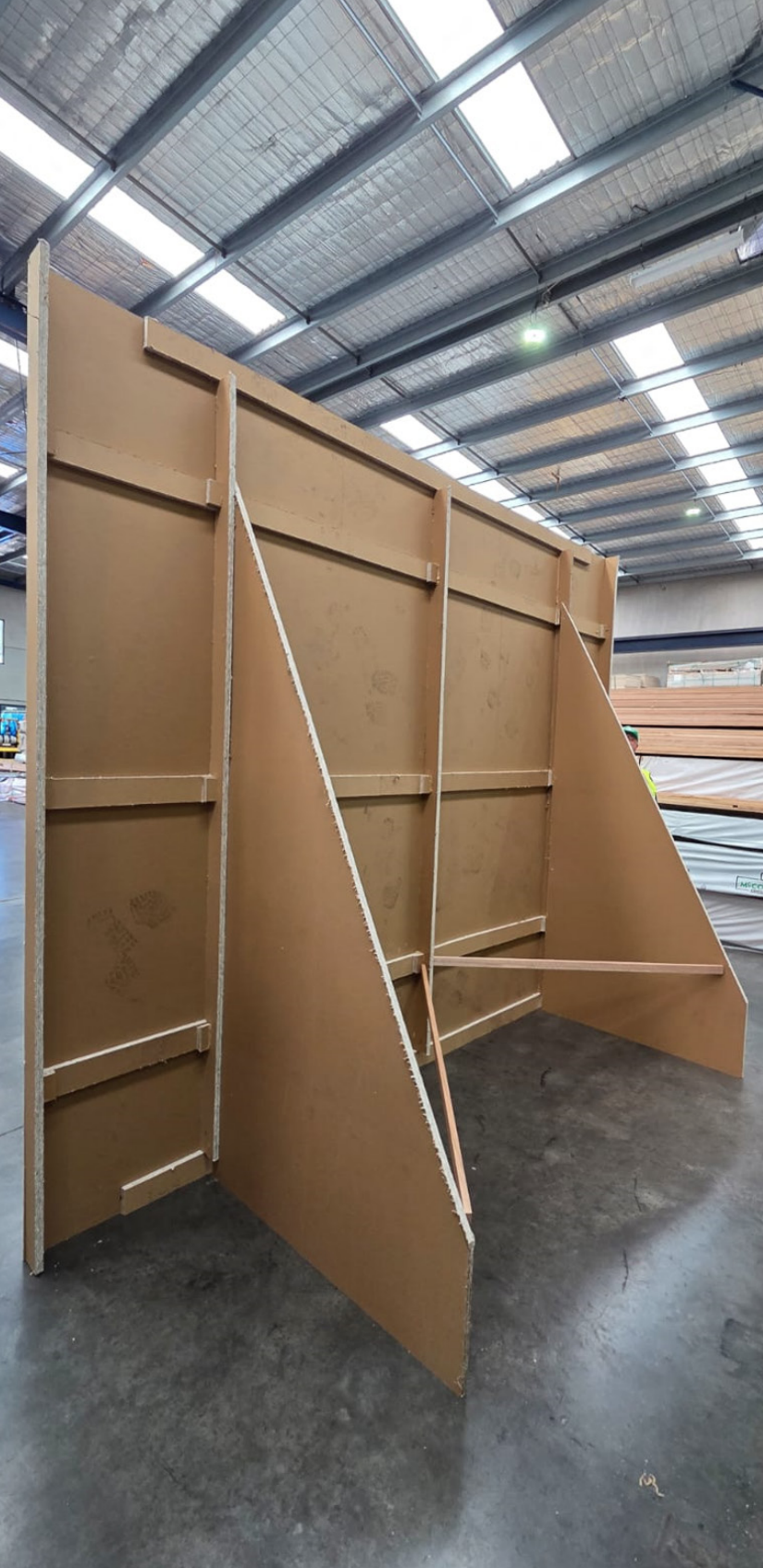
We built two test flats with McCormack's in Melbourne. The first had issues with dimensional consistency and board length. The second was square, smooth, clean-joined and moveable by two people. It performed. Saveboard can accept boards that have been painted, glued and plastered for reprocessing, meaning only minor changes to end-of-life handling. The one constraint is metal fixings: no screws or nails can go back into the press, which opens a question about composite plastic nails as a replacement.
The embodied carbon numbers are stark. Based on the 11 tonnes of timber products used on All Her Fault, replacing plywood panels with Saveboard and recycling them at end of life would avoid approximately 15,054 kg CO₂-eq, compared to 5,890 kg avoided under typical plywood-to-landfill practice. That is 2.6 times better.
What surprised us most was the response from the crew. Art directors, set builders, the whole production team were ready for this conversation. They wanted alternatives to foam rocks, MDF and single-use timber. The constraint was never willingness. It was access to technical knowledge, tested alternatives and local suppliers who could service production timelines.
That is where practices like ours fit. Not as auditors or certifiers, but as the link between material innovation and the people who actually build things. The film industry constructs and demolishes at a scale and speed that most sectors never encounter. It is a live laboratory for circular construction, if someone is willing to do the fieldwork.